
As electronic systems become smaller, more powerful, and more sensitive to heat, thermal management has become a critical part of product performance, safety, and reliability. Thermoelectric Cooling (TEC) chips, also known as Peltier modules, offer a compact, quiet, and highly controllable solid-state cooling solution for demanding applications.
Unlike compressor-based systems or conventional fans, TEC chips use direct electrical current to transfer heat from one side of the module to the other. This makes them especially valuable in applications where space is limited, vibration must be avoided, and temperature stability is essential.
The Physics Behind TEC
TEC technology is based on the Peltier effect. When direct current flows through two different semiconductor materials, heat is absorbed at one junction and released at the other. This creates a temperature difference across the module.
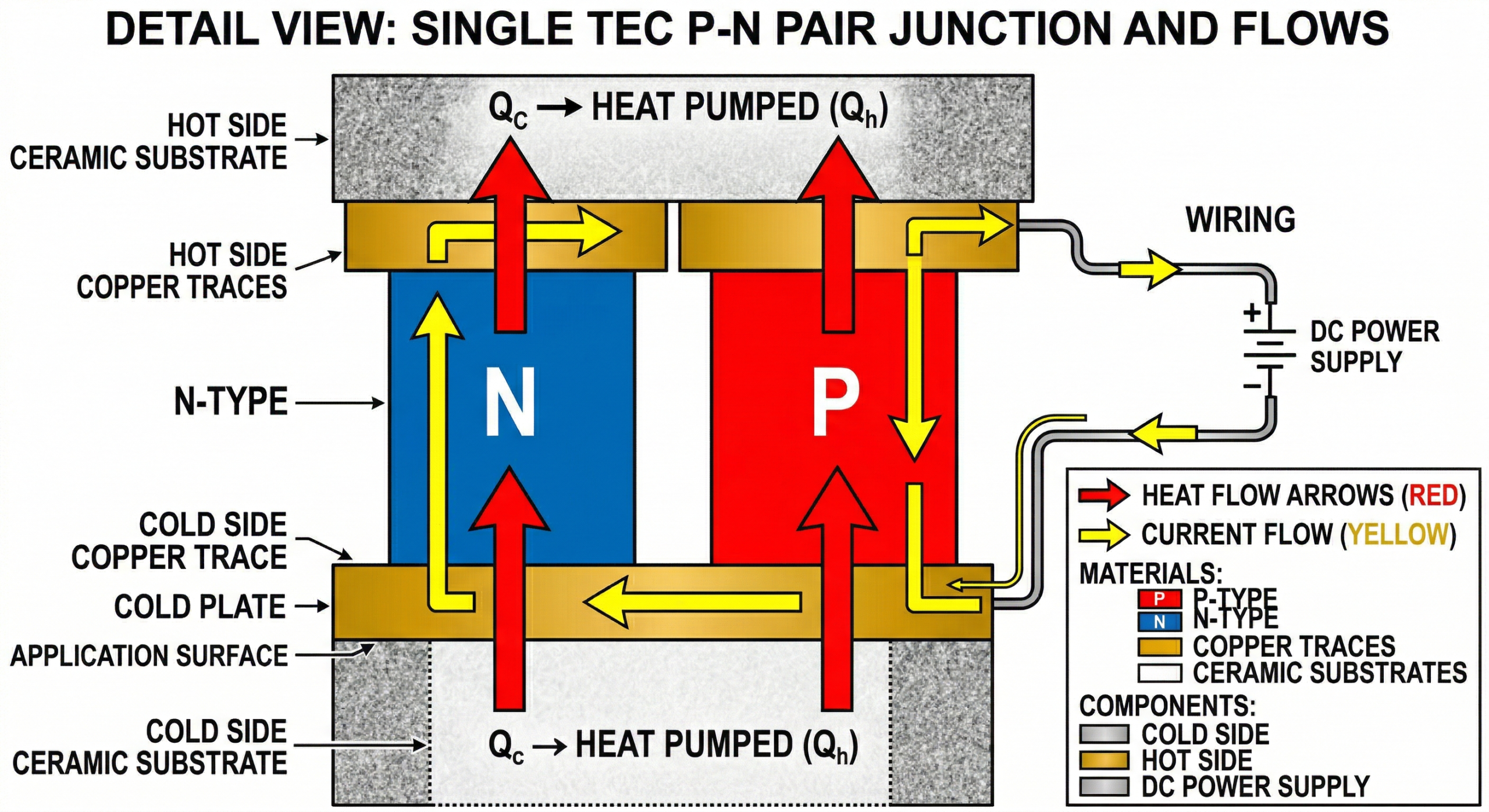
In a practical TEC chip, many p-type and n-type semiconductor couples are connected electrically in series and thermally in parallel between ceramic plates. As current flows through the device, heat is pumped from the cold side to the hot side. By reversing the current direction, the same module can be used for either cooling or heating.
The heat flow equation is:
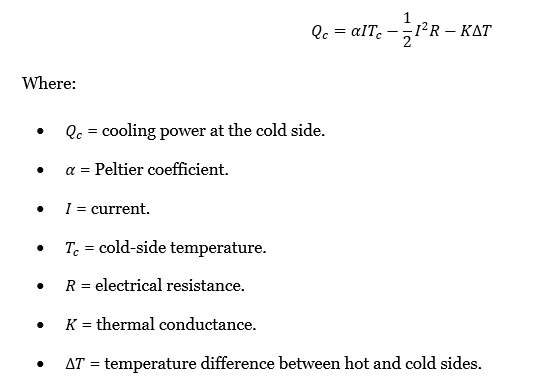
This equation explains the three major components of TEC behavior: the cooling effect, Joule heating, and thermal conduction losses. The Peltier term produces cooling, the Joule term reduces efficiency, and the conduction term works against the temperature difference.
The maximum cooling power occurs when:
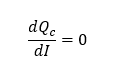
This indicates the optimal operating region for the module. In practice, performance increases with current up to a point, then declines as resistive losses become more significant.
How a TEC Chip Is Constructed
A thermoelectric cooling chip is built from many tiny semiconductor couples placed between two ceramic plates. These couples are made from p-type and n-type materials and are connected with metallic interconnects. The ceramic plates provide insulation, mechanical strength, and thermal stability.
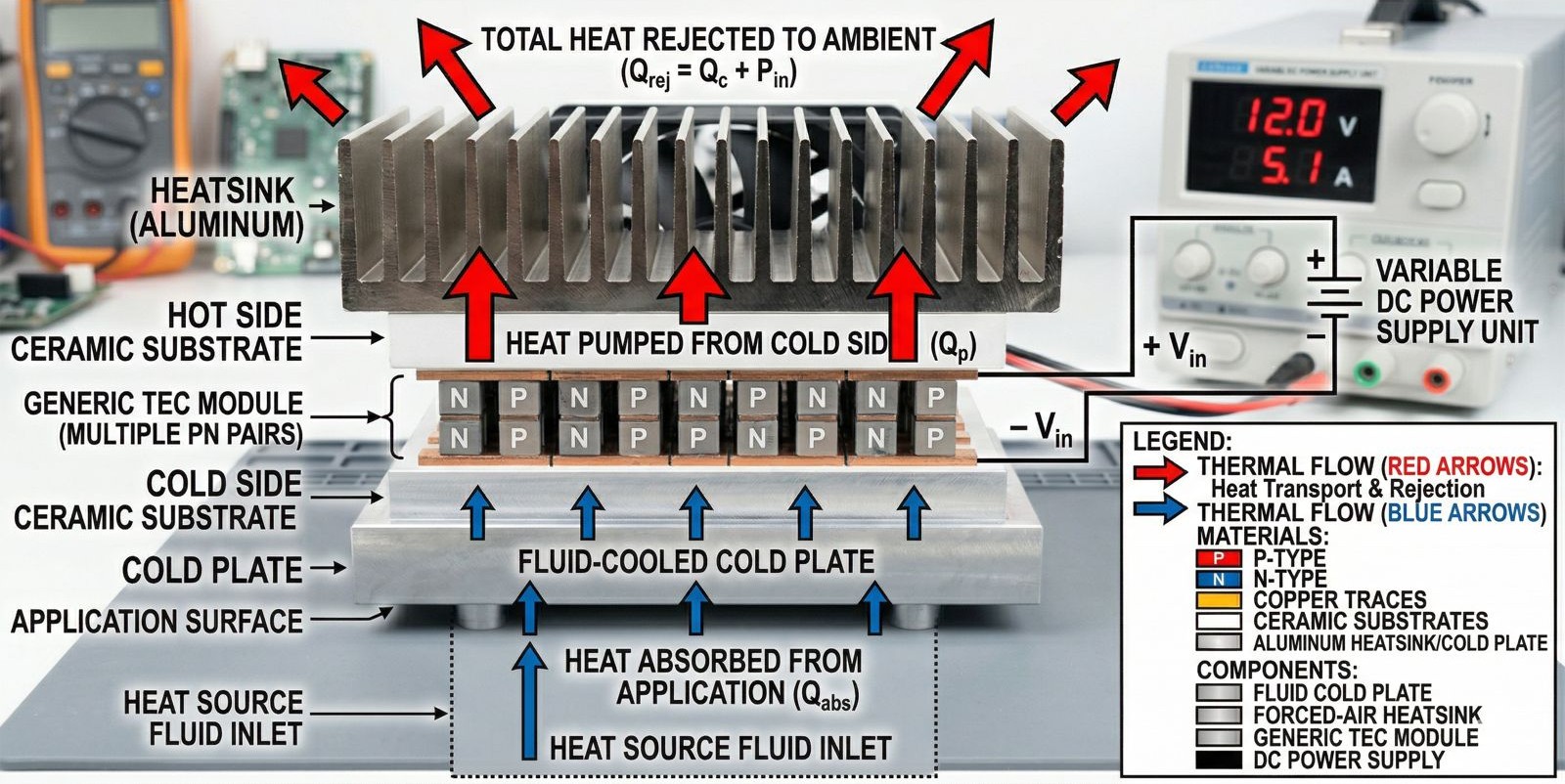
The module is typically mounted between a heat source and a heat-rejection system. The cold side contacts the component being cooled, while the hot side is attached to a heatsink, heat pipe, liquid cooling plate, or another thermal solution.
Common TEC sizes include 15 × 15 mm, 20 × 20 mm, 30 × 30 mm, and 40 × 40 mm. Thickness is usually around 3 mm to 3.9 mm, making these modules suitable for compact product designs.
Key Performance Parameters
When choosing a TEC module, several parameters are especially important:
- Qmax: the maximum heat the module can move under defined test conditions.
- ΔTmax: the maximum temperature difference the module can create with little or no heat load.
- Imax and Vmax: the maximum current and voltage at rated performance.
- Electrical resistance: affects power use and driver selection.
- Size and thickness: important for mechanical integration.
- Operating temperature range: important for long-term reliability.
A TEC module can only perform well if the hot side stays sufficiently cool. If the hot side becomes too warm, the temperature difference across the module decreases and cooling performance drops.
Advantages of TEC Technology
TEC chips offer several important benefits:
- Compact size and low weight.
- No vibration or mechanical noise.
- Precise temperature control through current regulation.
- Solid-state reliability with no moving parts.
- Fast response to changing thermal conditions.
- Bidirectional operation for both cooling and heating.
- Clean operation without refrigerants or compressors.
These advantages make TEC technology a strong choice when standard air cooling is too bulky, too noisy, or too imprecise.
Real-World Example
A practical test case uses a 40 × 40 mm TEC module with:
- Qmax = 94 W
- Imax = 15.7 A
- Material = Bi2Te3 pellets
The setup assumes:
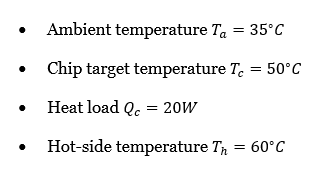
In this example, the TEC must handle not only the chip’s heat load but also conduction losses and the heat rejected at the hot side. The operating range shows that around 5.19 A to 6.47 A, the module can maintain the chip at 50 °C while delivering roughly 38.4 W to 49.2 W of theoretical cooling power. At around 6 A, the module can absorb the 20 W load with a power draw of about 45 W, resulting in a COPof about 0.44.
This shows an important reality of TEC design: precision cooling is possible, but the hot-side cooling system must be strong enough to support the full thermal load.
Typical Applications
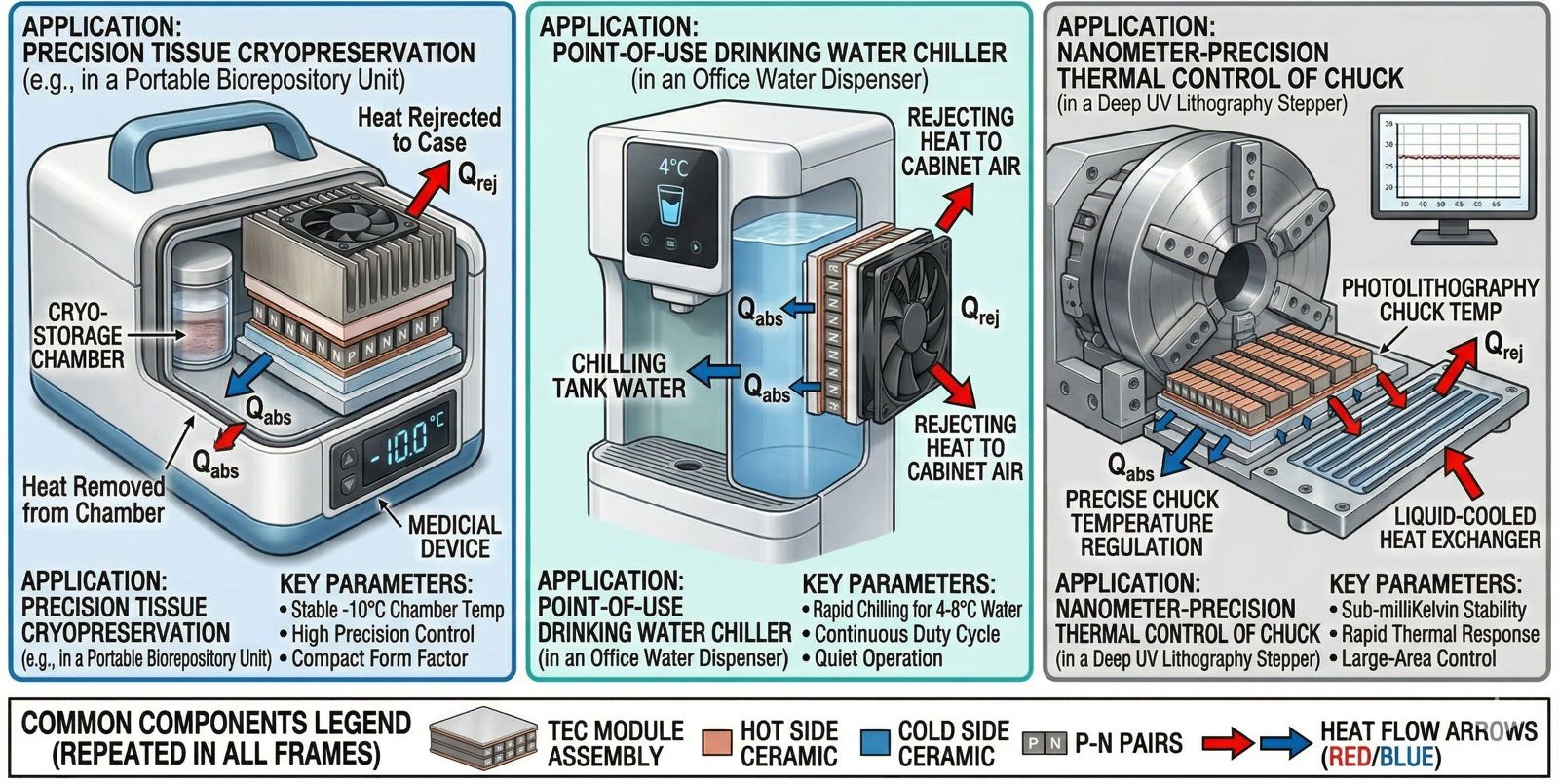
TEC chips are widely used in applications that require stable and localized thermal control, including:
- Medical devices.
- Laboratory and analytical instruments.
- Semiconductor testing equipment.
- Laser stabilization systems.
- Portable coolers and cold boxes.
- Drinking fountains and beverage coolers.
- Industrial and military electronics.
They are especially useful in fanless or vibration-sensitive equipment where thermal stability is just as important as cooling capacity.
System Design Considerations
A TEC module should never be treated as an isolated component. Its performance depends heavily on the overall thermal system around it. The hot side must be able to reject both the heat being pumped and the electrical power consumed by the module.
Important design factors include:
- Proper thermal interface materials.
- Strong hot-side heatsinking.
- Efficient airflow or liquid cooling.
- Accurate current control.
- Temperature sensing and closed-loop regulation.
- Correct clamping force and surface flatness.
- Condensation control when the cold side falls below dew point.
In high heat-flux or large temperature-difference systems, multi-stage TEC configurations may be required.
Conclusion
Thermoelectric Cooling chips are best understood as precision thermal tools rather than general- purpose refrigeration devices. Their strength lies in compact size, accurate control, quiet operation, and solid-state reliability. Their main limitations are efficiency and dependence on effective hot-side heat rejection.
When designed correctly, TEC technology can play a valuable role in medical, industrial, laboratory, telecom, and advanced electronics applications.
If you are designing medical devices, industrial instruments, telecom equipment, laboratory systems, or other thermally demanding products, thermoelectric cooling chips may offer the right balance of precision, compactness, and reliability.
To-Team’s engineers are ready to help you evaluate this technology, compare it with alternativethermal solutions and design a complete system tailored to your product requirements.
Contact us today to discuss your use case:
E-mail: [email protected]
Tel: +972.77.540.1143