
Navigating the Server Cooling Challenge: Liquid vs. Air in High-Density Computing
Server cooling decisions—liquid versus traditional air (fan-based)—now drive rack density, power use, reliability, and total ownership costs. As CPUs and GPUs surpass 300–700W per component and AI accelerators demand even more, thermal management shapes modern data centers and embedded systems. This choice goes beyond heat removal; it unlocks peak performance.
Physics Driving the Debate
Heat transfer efficiency lies at the heart of this debate. Water boasts a thermal conductivity 20–25 times higher than air and a volumetric heat capacity roughly 3,500 times greater.
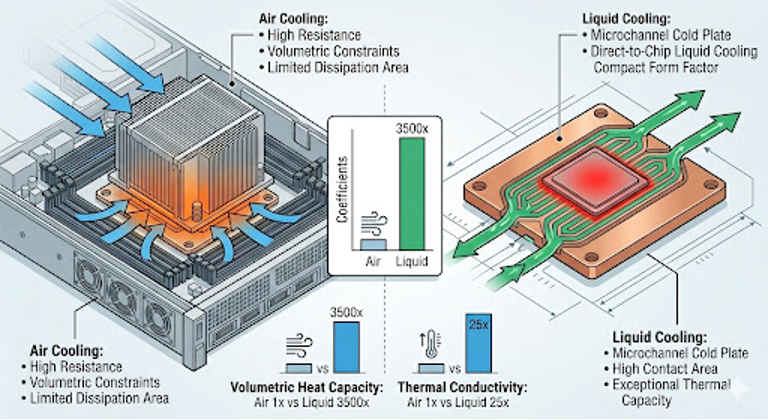
Figure 1: Comparative heat transfer schematic showing bulky air heatsinks vs. compact direct-to-chip liquid cold plates, highlighting liquid’s massive efficiency advantages per volume.
Key implications include:
- Efficiency: Liquids absorb and move far more heat per unit volume than gas.
- Form Factor: Air demands higher flow rates and bulkier heat sinks for equivalent dissipation, leading to “cluttered” chassis.
- The “Density Wall”: Rising power densities make air cooling geometrically and energetically unviable.
In high-density AI racks exceeding 30–60 kW—and hyperscale setups hitting 100 kW+—air cooling hits physical and economic limits.
Liquid Cooling: The High-Performance Leader
Liquid systems pull heat directly from processors using cold plates, immersion, or rear-door exchangers. This method is now essential for cutting-edge deployments.
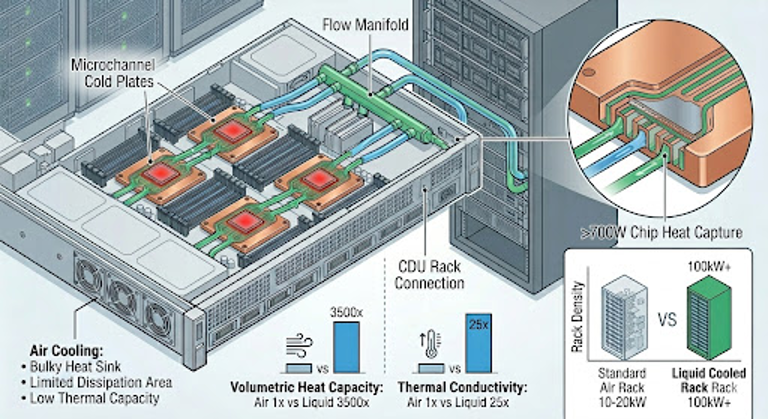
Figure 2: Direct-to-chip liquid cooling diagram within a server chassis, showcasing multi-chip microchannel cold plates, precise green coolant flow, and connection manifolds that enable >100kW per rack capability.
Key Advantages:
- Superior Thermal Transfer: Handles >1,000W per chip in cutting-edge setups.
- Space Optimization: Significantly boosts rack density by removing bulky fan assemblies.
- Sustainability: Improves PUE (Power Usage Effectiveness) by minimizing facility-wide HVAC requirements.
- Acoustics: Virtually eliminates the high-decibel noise of high-speed server fans.
Popular methods encompass direct-to-chip cold plates, single-phase immersion, two-phase immersion, and rear-door heat exchangers. Sealed, closed-loop designs slash leak risks, while quick-disconnect fittings simplify maintenance.
Challenges:
- Pumps need redundancy.
- Coolant requires precise chemistry control.
- Integration demands more specialized infrastructure.
- Upfront costs rise.
For AI training, HPC, and next-gen data centers, liquid cooling shifts from option to essential.
Air Cooling: The Reliable Standard
Air cooling remains the dominant force in enterprise data centers and embedded systems due to its simplicity, lower startup costs, simple deployment, easy upkeep, and widespread technician expertise.
Standard air-cooled racks handle 5–20 kW effectively. To push further, engineers must implement sophisticated airflow strategies.
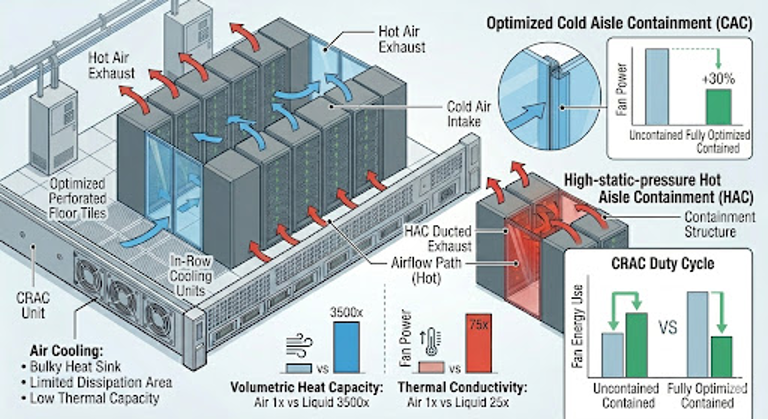
Figure 3: Data center air management diagram, illustrating hot and cold aisle containment, complex ducted airflow, and optimized floor tiles required to squeeze efficiency from high-density air-cooled setups.
Higher loads complicate airflow, requiring hot/cold aisle containment, high static-pressure fans, and raised-floor tweaks. At scale, air guzzles energy via fans and CRAC units, plus noise and space issues. It shines in edge computing, moderate enterprise racks, and budget-focused setups.
Insights from Automotive Evolution
This shift echoes the automotive industry: Early internal combustion engines (like the original VW Beetle) used simple air cooling for robustness. However, as horsepower and power densities soared, brands like BMW and Toyota shifted exclusively to liquid cooling for superior thermal management. Data centers are currently treading that same path.
Take the Next Step in Thermal Management
Are you ready to optimize your infrastructure for the AI era? Whether you are scaling a hyperscale cluster or upgrading an enterprise IT room, navigating the complexities of modern cooling demands expert knowledge.
Don’t let legacy thermal limitations throttle your performance potential.
Contact To-Team Today to find the perfect balance between performance and reliability.
E-mail: [email protected]
Tel: +972.77.540.1143